ChatGPT vs Gemini: Which AI is Best for Image Prompts?
“Artificial intelligence has transformed image generation, but choosing the right tool can be overwhelming. Compare OpenAI's ChatGPT (DALL-E) and Google's Gemini (Nano Banana) across prompting styles, quality, consistency, and editing.”
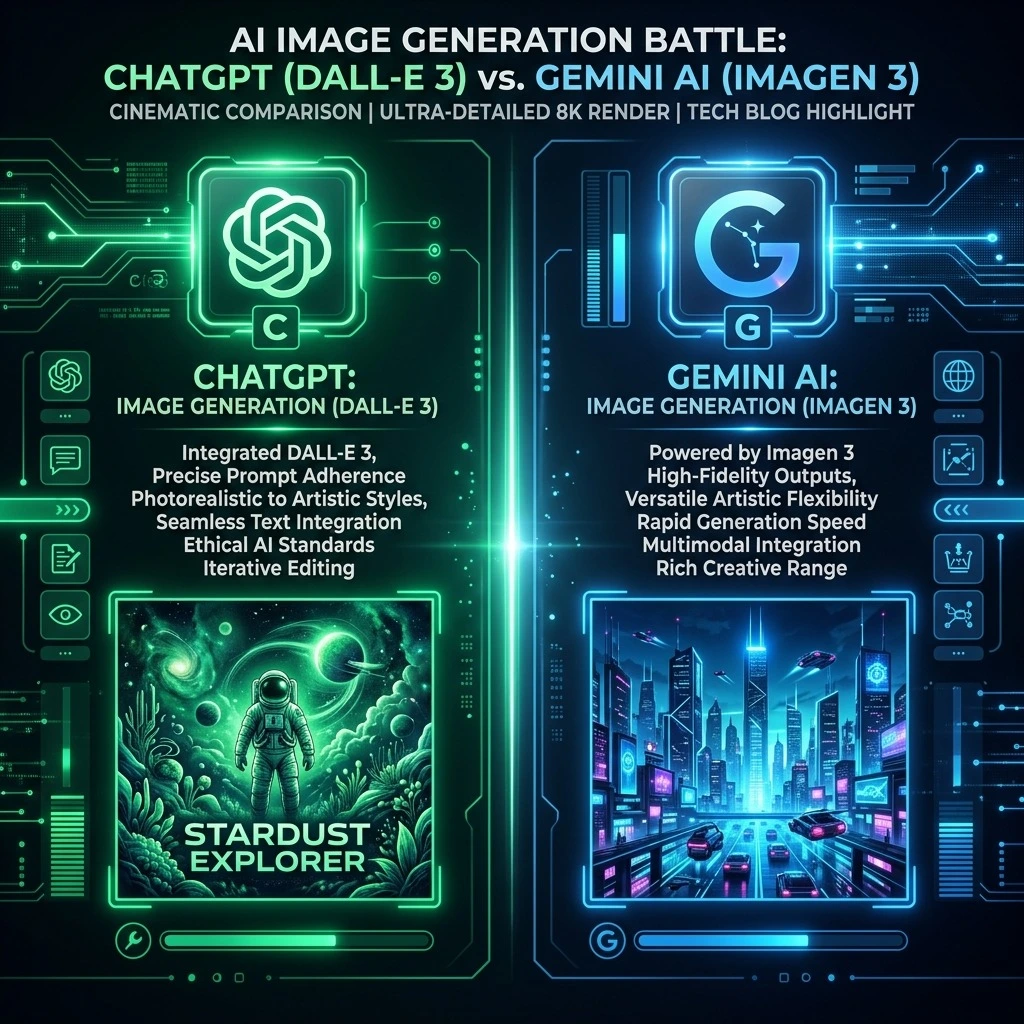
Artificial intelligence has transformed image generation, but with so many options available, choosing the right tool can be overwhelming. Two of the most powerful contenders are OpenAI's ChatGPT (powered by DALL-E) and Google's Gemini (with its native Nano Banana image models). Both are impressive, but they excel in different areas.
In this comprehensive guide, we'll compare ChatGPT and Gemini head-to-head across multiple dimensions—prompting styles, image quality, consistency, editing capabilities, and more—to help you decide which AI is best for your image creation needs.
The Contenders: A Quick Overview
ChatGPT Images (DALL-E)
ChatGPT's image generation is powered by DALL-E 3, OpenAI's state-of-the-art text-to-image model. When you describe an image in ChatGPT, the model automatically generates tailored, detailed prompts for DALL-E that bring your ideas to life. If you like a particular image but want adjustments, you can ask ChatGPT to make tweaks with just a few words. The system uses GPT-4 to optimize prompts before they're passed to DALL-E, a process called "prompt rewriting".
Gemini Images (Nano Banana)
Gemini's image generation is powered by the Nano Banana family of models—native multimodal models built on the Gemini 3 architecture. Unlike systems that bolt image generation onto a language model, Gemini was trained from the ground up to process text and images in a single, unified step. This native multimodal architecture enables powerful capabilities beyond simple image generation, including conversational editing, multi-image composition, and logical reasoning about image content.
Head-to-Head Comparison
1. Prompting Philosophy
The fundamental difference between ChatGPT and Gemini comes down to how they handle prompts.
ChatGPT acts as an intermediary. You describe your idea in plain English, and ChatGPT rewrites it into an expanded prompt for DALL-E. This means you don't need extensive prompt engineering background—ChatGPT handles much of the initial formatting. The model suggests a structure like: subject + environment/background + style + mood/lighting + specific details.
Gemini takes a different approach. With its deep language understanding, Gemini prefers narrative, descriptive paragraphs over keyword lists. The fundamental principle for Gemini prompting is simple: describe the scene, don't just list keywords. A well-written paragraph will almost always produce better results than a disconnected list of words.
Practical Example: When tested with the same basic request—"a sunflower made of sheet metal in a pencil drawing style"—both tools returned dramatically different prompts:
A pencil drawing of a metal sunflower with sculpted metal pieces, visible welds, detailed shading creating depth, pencil lines visible, set in a garden with blurry plants in the background.
A detailed pencil drawing of a sunflower constructed from sheet metal with visible seams, rivets, and subtle bends; the center composed of layered metal textures; rendered in realistic graphite pencil style with fine linework, cross-hatching, and soft shading; high contrast; minimal background.
Verdict: Prompting Philosophy
Both generated more detail than a typical user would know to add. Gemini suggested a more atmospheric scene (garden with blurry plants), while ChatGPT focused on technical precision (rivets, seams, cross-hatching).
2. Image Quality and Realism
When comparing Gemini and ChatGPT using identical prompts, community observations generally find Gemini performs consistently across a range of prompt types, while ChatGPT's DALL-E integration often produces richer detail on specific subject categories. Neither is universally superior—the best choice depends on the prompt type and intended output style.
| Aspect | ChatGPT (DALL-E) | Gemini (Nano Banana) |
|---|---|---|
| Visual Quality | ★★★★★ (Leader) | ★★★★☆ |
| Realism | ★★★★★ (Leader) | ★★★★☆ |
| Consistency | ★★★★☆ | ★★★★★ (Leader) |
| Detail Richness | ★★★★★ | ★★★★☆ |
This aligns with a 2025 test that concluded Gemini "is now more useful than ChatGPT for creating images that look real," with cleaner adherence to scene constraints. ChatGPT, however, excels at producing images with higher visual polish and photorealism.
3. Prompt Adherence and Consistency
Gemini has a notable edge in consistency. It preserves fine-grained detail and adheres reliably to multi-constraint prompts, even with multiple simultaneous requirements. This means if you give Gemini a complex prompt with many specific elements, it's more likely to deliver all of them accurately.
ChatGPT is highly capable but can sometimes reinterpret your request in unexpected ways. The prompt rewriting feature, while helpful, means you're not always seeing exactly what DALL-E receives. If you want to debug, you can ask ChatGPT to display the prompt that was sent to DALL-E.
Gemini's consistency advantage was highlighted in a 2026 ranking where it scored highest overall due to its consistency.
4. Editing Capabilities
This is where the differences become stark.
ChatGPT (DALL-E) allows for conversational editing. You can ask for tweaks with just a few words, and ChatGPT will handle the rest. You can generate variations and use seed numbers to maintain a consistent style. However, editing is primarily done through regenerating with modified prompts.
Gemini (Nano Banana) offers significantly more advanced editing capabilities thanks to its native multimodal architecture:
- Conversational editing: Add, remove, or modify elements; change style; adjust colors
- Multi-image composition: Use multiple input images to compose a new scene or transfer style
- Iterative refinement: Progressively refine images over multiple turns
- Precise local edits: Make changes to specific parts of an image using simple language
- Character consistency: Preserve a character's appearance across multiple generations
- Style transfer: Apply a style, texture, or design from one concept to another
Gemini's editing is truly conversational and iterative. You can generate an image, then say "change the lighting to golden hour" or "make the background more dramatic" without starting from scratch.
Verdict: Editing Capabilities
Gemini wins decisively on editing capabilities.
5. Text Rendering
Both models have improved significantly in text rendering, but there are important distinctions.
Gemini 3.1 Flash Image (Nano Banana 2) and Gemini 3 Pro Image (Nano Banana Pro) can generate images that contain clear and well-placed text, making them ideal for logos, diagrams, and posters. However, even Gemini can still struggle with accurate spelling and fine details in images. For best results, provide the exact text you want in quote marks.
ChatGPT also handles text reasonably well but historically has struggled more with text rendering than Gemini's latest models.
6. Technical Specifications
| Feature | ChatGPT (DALL-E) | Gemini (Nano Banana) |
|---|---|---|
| Native Multimodality | No (bolt-on) | Yes (trained from ground up) |
| Context Window | Varies | Up to 131K tokens |
| Output Resolutions | Up to 4K | Up to 4K |
| Aspect Ratios | Multiple | 10+ ratios including 16:9, 9:16, 21:9 |
| Reference Images | Limited | Up to 14 |
| Multi-Image Composition | Limited | Yes |
| Character Consistency | Limited | Yes |
| Google Search Grounding | No | Yes |
7. Usage Limits
Usage limits can be a deciding factor for heavy users.
ChatGPT typically limits free users and daily caps may apply depending on demand and plan. Availability can vary based on platform traffic.
Gemini and Grok offer generous daily usage for standard prompts, though specific rate limits vary by subscription tier and current platform policy.
A Single Prompt Tweak That Makes a Big Difference
Here's a powerful technique that works for both platforms: let the AI write its own prompt.
Instead of struggling to craft the perfect prompt yourself, simply ask the chatbot to generate one for its corresponding image generator:
I would like to create an image of [your idea]. Generate a prompt that I can use to request this image from [Nano Banana or ChatGPT Images].
This approach has multiple benefits:
- The AI knows exactly what its image generator responds to best
- It automatically includes details you wouldn't think to add
- It avoids language that the generator might flag or refuse
If the generated prompt is too long, simply ask for a shorter version.
Which One Should You Choose?
Choose ChatGPT If:
- You want the highest visual quality and realism. ChatGPT consistently ranks higher on visual quality and richness of detail.
- You prefer a hands-off prompting experience. ChatGPT rewrites your rough ideas into optimized prompts automatically.
- You're creating photorealistic or highly polished images.
- You don't need extensive iterative editing.
Choose Gemini If:
- You need consistency across multiple images. Gemini's character consistency and prompt adherence are unmatched.
- You want powerful editing capabilities. Conversational editing, multi-image composition, and local edits are Gemini's superpowers.
- You need text rendering for logos, posters, or diagrams.
- You're building a brand or character that needs to appear consistently across generations.
- You want to use reference images—Gemini supports up to 14.
- You want Google Search grounding for factually accurate images.
The Bottom Line
Both tools are excellent, but they serve different needs:
Summary Verdict
Gemini obtained the highest overall score thanks to its consistency, while ChatGPT led in aspects more related to visual quality, such as realism and richness of detail.
If you need a single, stunning, photorealistic image with minimal effort, ChatGPT is your best bet. If you need to create a series of consistent images, edit them conversationally, or compose complex scenes from multiple references, Gemini is the superior choice.
The Best of Both Worlds
Many professionals use both tools strategically:
- Use ChatGPT for hero images, marketing visuals, and photorealistic scenes
- Use Gemini for brand assets, character consistency, multi-image composition, and iterative editing
The good news? Both platforms are constantly evolving. By 2026, the gap between them has narrowed significantly, and both produce images that would have been unimaginable just a few years ago.
Final Thoughts
The "best" AI for image prompts ultimately depends on your specific needs. ChatGPT excels at producing visually stunning, realistic images with minimal prompting effort. Gemini excels at consistency, editing, and complex multi-image workflows.
Try both. Use the "let the AI write its own prompt" technique for each. See which one delivers results that align with your creative vision. And remember—the most impressive AI images often come from experimentation and iteration, regardless of which tool you choose.